June 13, 2012

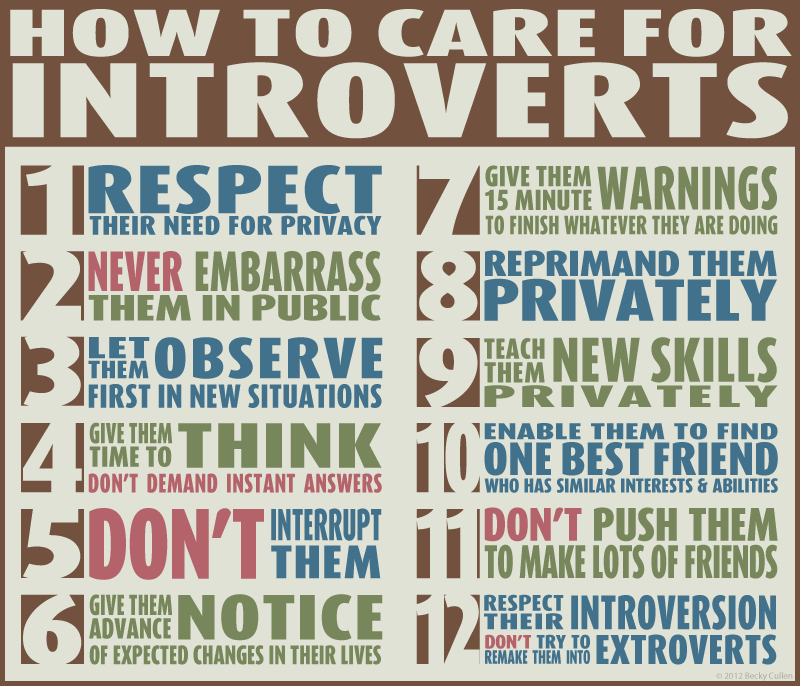
It's Just My Personality - Part 3: Being An Introvert

It's 7:00 AM. Your boss calls you at home and tells you to take the day off - everything is covered. What will you do with your unanticipated free day?

If you said, "Chill out at home alone, read a book, go for a solitary stroll," you are likely an introvert.

Being an introvert isn’t so much about being shy or not outgoing. It’s more about where you get your energy from.

As an introvert, you are energized:
  • By the internal world of reflection & contemplation 
  • When taking in information or ideas 
  • By quiet time alone
  • By thinking things through
This means that you are recharged and invigorated by time alone and prefer to have time to reflect and think things over before acting. Therefore, it is extremely important to carve out time for yourself during the week to get away. Introverts who don’t make time for reflection and solitude usually pay the price – they crash (either physically or mentally). Being with others drains an Introvert's energy level, so it is very important to set aside time to recharge!

At work and play, the Introvert:
  • Seeks quiet time for concentration & needs time to be alone 
  • Prefers interests that have depth 
  • Fore-thinkers 
  • Sometimes hesitates to act
One trap that Introverts fall into (aside from overscheduling) is that they spend too much time in reflection, become paralyzed, and find it difficult to get into action. They begin to think “too much” and get stuck. To avoid this trap, it can be helpful to set out a time limit for your reflection period (e.g. “I’ll make a decision on this by Friday.”).

Here’s an interesting article on how the workplace has changed over the last century in a way that puts Introverts at a disadvantage in many ways.

Finally, when it comes to communication, Introverts:
  • Pause before responding 
  • Process information internally 
  • Prefer written over verbal communication 
  • Prefer to work independently
Understanding your communication style is extremely helpful – especially when you are communicating with an Extrovert, who will prefer to talk things out, which can leave an Introvert feeling drained and overwhelmed.

Introverts can come across as distant or unengaged. So, developing the skill of being clear that you have heard the communication and then asking for time to reflect can be a real life saver for Introverts. Avoid the pitfall of trying to respond too quickly. You will usually regret your answer and have to do more work in the long run.

When it comes to E’s and I’s getting along, these two graphics sum it up nicely!


If you are an I interacting with an E:
  • Allow E’s to process with you
  • Understand that everything said isn’t acted upon
  • Offer outlets for stimulation and connection
 If you are an E interacting with an I:
  • Allow I’s time to think alone 
  • Don’t assume I’s aren’t thinking just because they aren’t talking 
  • Offer outlets for solitude and rejuvenation
Next week, we’ll be talking about the next personality type, Sensing (S) and then, after that, the S counterpart, Intuition (N).


---

Discover the 3 Stages of Recovery from Childhood Abuse

The road to recovery is much easier when you know what stage you're in and what to do next. Find out exactly where you are in your healing journey and what kind of support you need right now. 
This FREE 9-page guide will give you the answers you've been seeking.


June 6, 2012

It's Just My Personality - Part 2: Being An Extrovert

It's 7:00 AM. Your boss calls you at home and tells you to take the day off - everything is covered. What will you do with your unanticipated free day?

If you said, "Go out with some friends, catch dinner with some folks, plan a group outing," you are likely an extrovert.

Being an extrovert isn’t so much about whether or not you are outgoing or comfortable in groups. It’s more about where you get your energy from.

As an extrovert, you are energized:
  • By the external world of people, activities and things 
  • When trying things out 
  • By interaction with others 
  • By talking things out
This means that you are recharged and invigorated by social interaction and prefer talking through ideas rather than going off on your own to reflect.

One trap here though is to end up thinking that every idea shared needs to be acted on. I call it “extrovert overload.” As you begin "talking things out," you hit upon idea after idea - “We could do it this way..”, “Or how about this…!”

Before you know it, you have 20 ideas on the table and are feeling overwhelmed - either not knowing which one to choose or thinking you have to do it all. To avoid this, think of your “talking things out” time as a bit of a download rather than as an action list.

At work and play, the extrovert:
  • Seeks variety & action, can get bored easily 
  • Wants to be with others 
  • Prefers interests that have breadth 
  • After-thinkers
For the extrovert, alone time is still important, but it drains energy rather than restores. If you find yourself feeling run down, tired, or bored, re-charge by getting into action or going out and being around others.

Finally, when it comes to communication, extroverts:
  • Require less personal space 
  • Speak louder & more quickly than introverts 
  • Use more physical gestures & facial animation than introverts 
  • Like to meet face-to-face
  • Blurt! 
Understanding your communication style is extremely helpful – especially when you are communicating with an Introvert, who will prefer to listen to a few ideas, go off and reflect and then return to develop a plan of action.

Extroverts can come across as overbearing, intimidating, or overwhelming. So, learning when to turn it down a notch, to tune into the energy level of the person you are communicating with, and developing some skills to avoid blurting out whatever is one your mind are all good places to start for Extroverts.

Next week, we will be talking about Introverts (I), the counterpart to the Extrovert (E) personality and also exploring how E’s and I’s can get along!


---

Discover the 3 Stages of Recovery from Childhood Abuse

The road to recovery is much easier when you know what stage you're in and what to do next. Find out exactly where you are in your healing journey and what kind of support you need right now. 
This FREE 9-page guide will give you the answers you've been seeking.


May 30, 2012

It's Just My Personality - Part 1: Exploring Myers-Briggs

I've long been fascinated by the Myers-Briggs Personality Test, and I often start off having new clients take this test (a free online version can be found here) to get a general sense of how they tick.

This questionnaire, originally developed by Katharine Cook Briggs and Isabel Briggs Myers, was designed to measure the psychological preferences in how people perceive the world and make decisions as informed by the theories proposed by Carl Jung in his book, Psychological Types.

The four dichotomies that make up the personalities types are:

Extraversion (E) - Introversion (I) 
Sensing (S) - Intuition (N) 
Thinking (T) - Feeling (F) 
Judging (J) - Perceiving (P)

These can then be combined to result in a four letter personality type (e.g INFJ, ESTP).

While this particular personality test doesn't cover all of the bases, it certainly highlights key characteristics and tendencies of behavior and perception that are commonly shared among those with a particular personality type. Understanding how some of our behavior, attitudes, and perspectives are driven by personality can be very useful and liberating. 

So, for the next eight weeks, I'll be breaking down each type to explore the way a person of that personality type might perceive the world and make decisions.

I encourage you to take the online version of the test, so you can know which posts to pay particular attention to, but I encourage you to read all of the posts in the upcoming series. Knowing how the other half sees the world can also be very useful!

TIP: When taking the test - don't over-think your answers - just go with your first, gut response!


---

Discover the 3 Stages of Recovery from Childhood Abuse

The road to recovery is much easier when you know what stage you're in and what to do next. Find out exactly where you are in your healing journey and what kind of support you need right now. 
This FREE 9-page guide will give you the answers you've been seeking.


May 16, 2012

Finding Your Purpose as an Adult Survivor

I recently had the opportunity to be interviewed by Rémy Chaussé, bestselling author of Living Life as an Exclamation Point! We had a great time together, and, to quote Rémy:


"Exclamation points are those incredible, amazing, unforgettable moments that make you feel lucky to be alive. They flood your world when you fall in love! When you get that amazing new job! When things are just absolutely perfect!"


Another exclamation point in life is discovering our purpose(s) and going after it. Yet, we often feel blocked, unclear of how to discover our purpose, or are just outright scared! In this interview, I share 5 Steps to Finding Your Purpose as an Adult Survivor of Child Abuse, but these steps can be used by anyone.


I think the best discovery I have made along the way is that I don't have "a" purpose. I have many purposes! And furthermore my purpose can evolve and change. I discovered that making this shift created room and possibility and playfulness rather than finding purpose remaining a task or chore that I had to complete. 


Remember, your purpose isn't just about what job you have or what you are out in the world doing - it is also directly tied to who you are being! For example, one of my purposes is working with adult survivors to overcome the effects of abuse. However, one of my other purposes is to be encouraging and an inspiration. In fact, one of the main mistakes I find we make when exploring this topic is to focus too much on trying to figure out what it is we want to do and too little time on who it is we want to be.


If you would like explore this idea further, click here for an exercise I use with my clients who are seeking to get a clearer picture of who they want to be.


---

Discover the 3 Stages of Recovery from Childhood Abuse

The road to recovery is much easier when you know what stage you're in and what to do next. Find out exactly where you are in your healing journey and what kind of support you need right now. 
This FREE 9-page guide will give you the answers you've been seeking.


May 9, 2012

One Man's Story of Healing from Sexual Abuse

I would like to share with you today the story of Marko Hamlin, a male survivor of childhood sexual abuse. 

I make the point here of highlighting Marko's gender because so often the stories of men who have been abused go untold or are ignored or discounted.

We live in a time when emotional [I would add sexual abuse as well] abuse is not something that men are able to identify with because they are often ridiculed for acknowledging that they have emotions. When men are emotional, women and men often call them soft, weak, gay or homosexual and feminine. These references to the association of weakness and emotional needs of men are often just as abusive and traumatizing as when the man was first violated.

While I am beginning to see more and more male survivors coming forward, seeking support, and telling their stories, there is still work to be done. 1 in 6 men have experienced abuse - they deserve our attention and support!


---

Discover the 3 Stages of Recovery from Childhood Abuse

The road to recovery is much easier when you know what stage you're in and what to do next. Find out exactly where you are in your healing journey and what kind of support you need right now. 
This FREE 9-page guide will give you the answers you've been seeking.


Sign up for my free guide so you can stop spinning your wheels and instead navigate your way through each stage of recovery with ease and clarity. Get the support you need today