April 25, 2012

Connected, but Alone?

I recently came across this amazing Ted Talk in which Sherry Turkle, a professor at MIT in the Program in Science, Technology and Society, explores our relationship to and use of technology and how this is impacting our relationships with others.

As Turkle says,
"The feeling that 'no one is listening to me' makes us want to spend time with machines that seem to care about us."
Now, I know this is not a new topic, but I think Turkle's perspective on how technology is impacting us individually and in relationship reaches the heart of the matter in an intuitive and insightful way.


I want to encourage you to watch and then reflect on these questions:
  • How confident am I in my own abilities to have a conversation, to connect with others in real time?
  • How do I use technology to satisfy my need for connection?
  • Can you relate to what Turkle says about the feeling of "no one is listening"? If so, is it technology alone that you use as a salve or other things as well (work, over-scheduling, addictions, etc.)
  • Turkle encourages us to first start seeing "solitude as a good thing. Make room for it." How can you create and embrace solitude?


---

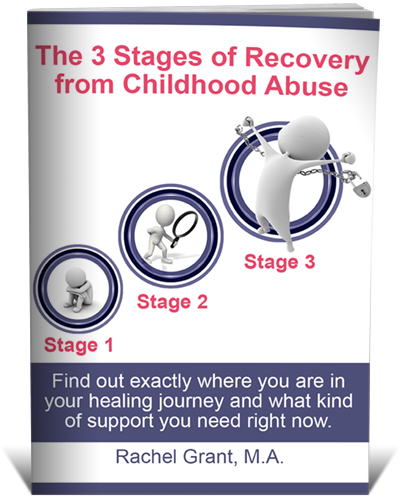
Discover the 3 Stages of Recovery from Childhood Abuse

The road to recovery is much easier when you know what stage you're in and what to do next. Find out exactly where you are in your healing journey and what kind of support you need right now. 
This FREE 9-page guide will give you the answers you've been seeking.


April 18, 2012

It Is Time to Forgive...

This week, I would like to share some thoughts on forgiveness. It is not a term you hear much outside of the spiritual/religious world – at least not stated so bluntly. Yet, we all carry around hurts that have not healed or grudges that we still bear that are dragging us down or keeping us from moving on, and that is just no way to live!
 
One major obstacle that stands in the way of our forgiving is that we have all the wrong ideas about what it means to forgive in the first place. It is important to understand that forgiveness (adapted from Shelter from the Storm):
  • Does not mean what the person did was okay 
  • Does not mean the person has permission to hurt you again 
  • Does not mean the offense was not great 
  • Does not depend on the person saying s/he is sorry 
  • Does not mean that the offense was not deliberate or repeated
We often fall into the false belief that forgiveness means letting the person off the hook and accepting the injustice of it all. Quite the contrary – forgiveness is about letting ourselves off the hook! Both the Greek and the Hebrew verbs for forgive can be translated “to send away.”

Forgiveness is about sending away the hurt, pain, anger and bitterness and taking back our life. We also send away the person who hurt us and his/her hold upon our thoughts, emotions, and experiences in the present day when we forgive.

Most importantly, forgiveness is a choice – not a feeling. Since it is a choice, making a decision to forgive can be arrived at by examining both our reasons for and against forgiving the abuser (this is similar to looking for the payoffs and costs).

Spend some time reflecting on your reasons for and against forgiving, but, first, consider what Kubetin-Littlefield has to say on the matter:
“... many of us mistakenly believe that unforgiveness will somehow hurt those who hurt us. By refusing to offer forgiveness, we hope to ‘get even’ with them. But the opposite is true. Abusers [people who hurt us], unforgiven, go right on doing what they do. They never considered us in the first place, and our unforgiveness has absolutely no [effect] on their behavior.”
My reasons not to forgive:
My reasons to forgive:

There are some very real consequences of choosing not to forgive. I love this clip from “Woman Thou Art Loosed.” The main character, Michelle, is raped by her mother’s boyfriend when she is 12 years old. As an adult, Michelle is struggling to make sense of the hard life she’s had and the abuse she experienced. This clip begins with a visit from her parole officer and ends with her arriving at a revival where she attempts to let go of the past – but doesn’t succeed.

One of the main lessons we learn from Michelle’s story is that we have the opportunity to look ahead and not behind, to leave our pain and hurt “at the altar” so to speak. But not doing so can have serious consequences. In Michelle’s case, she literally ends up jailed – never to be free (at least physically) again. What are the consequences for you of not forgiving?

In order to leave the past behind, we need to understand that (adapted from Shelter from the Storm):

  • We cannot genuinely forgive until you acknowledge the full scope and impact of the offense. 
  • We cannot forgive and deny the offense at the same time. 
  • We cannot forgive someone else for an offense and carry responsibility for that same offense yourself. 
  • We cannot carry shame for an offense yourself and at the same time forgive someone else for it.

In other words, if we are continuing to blame ourselves for what happened, then there is nothing to forgive, the person has done nothing wrong. We must take responsibility for any part we played, but, until we hold the person accountable, there is no space to forgive and move on.

I encourage you to create a “Leaving It All Behind” list. Write down all of the things you are ready to leave behind, forgive others for, and forgive yourself for. Then, find a moment to read over your “Leaving It All Behind” list. After reflecting and truly committing to leaving it behind, dispose of the list in some way that feels meaningful to you – e.g. burn it, shred it, toss it into the ocean.


---

Discover the 3 Stages of Recovery from Childhood Abuse

The road to recovery is much easier when you know what stage you're in and what to do next. Find out exactly where you are in your healing journey and what kind of support you need right now. 
This FREE 9-page guide will give you the answers you've been seeking.


April 3, 2012

Our Wounds As Bridges to Intimacy

Hi all,

Today, I would like to share a poem written by a fellow beyond survivor who I've had the great pleasure of getting to know over these past few months.

In his words, this poem,
"expresses how child abuse removes one from himself and his tribe, the ensuing effort to find one's place within and without that center, and the realization that the ideal has no place for him as he had conceived it; that one must find his own way within the ambiguity, and perhaps the ambiguity itself holds an answer. It's about meeting someone who recognizes his injuries and reflects them, and how ultimately the wounds themselves become a bridge to intimacy."

Two Survivors 

She threw back the gates of her isolation
and absorbed me
beneath the ages
of earth in her face
To the buried city
where children had played

We spoke of the fall
God and rain falling from the sky
Father's falling bootsteps toward the room
Blood and angels on the floor
We were ghosts and ghosts of ghosts
when they were through

Voiceless ghosts in the cells of Alcatraz,
who, when the ocean was still
heard the laughter of women
high and soft across the water
And scratched out our replies in the walls

The muted ghost of Maya Angelou
Who would not allow poetry to be raped from her soul
But would give it willingly
To a more kind world

We watched America from windows
Spied the night fires of Eden
from the hills

Watched  the baptist from the shores
Drank the water, and tasted every sin

Smoked and threw dice
against the pearly gates

maddened by silence
We screamed out in the canyons
To hear the mountains say our name

and we carried more than we wanted
And less than we needed
On the long walk out

To gather new countries around us
of carnival mirror souls
Who reflected, not beauty but recognition
and that was enough

"Does it ever come back to you?" She asked.
"All the clarity and wisdom and love?"

I said, "Its like being on a train
and looking thru the window of the next train
and seeing yourself
and he looks back at you
But the train slowly pulls away
and you watch yourself go."

As we talked I thought of Helen Keller
Raging in her inarticulation
And how those first words to her teacher
must have felt like being born

And I wondered if Helen
ever met anyone like herself
with neither sight nor sound
And what secret language
They must have whispered
Into each other's hands

--
It is no small thing to share something so intimate, so I hope you will take a moment to share your thoughts, feelings, or insights - or even just gratitude to the author for sharing. Every day, I believe more and more that healing is a collective effort, and I count myself lucky to be surrounded by so many amazing and strong individuals such as the author of this poem.



---

Discover the 3 Stages of Recovery from Childhood Abuse

The road to recovery is much easier when you know what stage you're in and what to do next. Find out exactly where you are in your healing journey and what kind of support you need right now. 
This FREE 9-page guide will give you the answers you've been seeking.


March 14, 2012

Entering into Intimate Relationships

One of the biggest payoffs of learning to trust (ourselves and others) and embracing vulnerability is intimacy, which is something we are built to need and crave. Before we delve into the work of identifying the reasons why we avoid intimacy and how to break free of the patterns that are keeping us from experiencing all of the goodness that comes from intimate relationships, let’s spend some time considering what intimacy is. After all, if we do not know what it is, how will we know when we have it?! Once, I came across this definition of intimacy that I really liked:
"Private and personal knowledge detailed and obtained by much study or experience."
Intimacy involves both the ability to give and receive love and grows over time as we have experiences with or “study” the person we are connecting with. One of the main problems we experience having been hurt in the past, however, is that we tend to jump ship well before any of that can happen. Thus, our relationships remain superficial – never delving into detailed private and personal sharing. Why is that? Why do we avoid intimacy like it is the plague? We have a whole host of fears and false beliefs that need to be challenged and unraveled in order to break free from the isolation that occurs when we avoid intimacy, such as (from Shelter from the Storm):
  • Intimacy means that we blindly trust people.
  • Intimacy means physical or emotional isolation.
  • Intimacy means betrayal.
  • Intimacy means agreeing with another person when you know that person is not right.
  • Intimacy means disclosing private or personal information when you do not want or wish to.
  • Intimacy means abuse.
Based on the fact that we need and desire intimacy, when we try to avoid or detach from this need, we usually compensate in some way. We engage in various behaviors to avoid intimacy (adapted from Shelter from the Storm):
  • Substituting (e.g. perfectionism, false compassion, attention demanding behavior)
  • Compulsive Behaviors (e.g. eating, smoking, shopping, sex, work, religion, TV)
  • Suppressing the Need
  • Fantasy
  • Self-pity
  • Anger
  • Unforgiveness/Rigidity
  • A Judgmental Attitude
  • Over-scheduling
We engage in all of these behaviors because we are trying to avoid the loss that comes when intimate relationships end or because of the false beliefs we have about what comes along with intimacy. Answer the next question: By never entering into intimate relationships, I get to avoid… But consider this: any behavior we use to avoid losing, actually causes us to lose! We have seen time and again the costs of trying to outrun or ignore any of our basic human needs. Answer this question: By never entering into intimate relationships, I never get to experience… One of the biggest reasons we avoid intimate relationships is that we ourselves do not know how to engage in a healthy way. We either isolate ourselves or become possessive or smothering should we connect with someone.

Remember that intimacy includes the ability to both give and receive love. If we are isolating ourselves from others, there is no opportunity for an exchange. If we are possessive and smothering, then we are stuck in a mode of only taking and not giving. Our needs are center stage and the other person is being held accountable to make sure that we are constantly reassured, comforted, and paid attention to.

Furthermore, if we are engaging in any of these behaviors, we are also, once again, on the control wagon! By either managing ourselves or others, we are hoping to eliminate the risks that come along with intimacy.

To begin the process of first identifying what intimacy is for you, I encourage you to create an “Intimacy Is…” collage. You can go whole hog and whip out magazines, glue stick, and construction paper or you can create a spreadsheet. The important thing is that you spend some time reflecting on what you would like to know and believe about intimacy – e.g. Intimacy is a walk on the beach, adventure, a risk worth taking, pillow talk.


---

Discover the 3 Stages of Recovery from Childhood Abuse

The road to recovery is much easier when you know what stage you're in and what to do next. Find out exactly where you are in your healing journey and what kind of support you need right now. 
This FREE 9-page guide will give you the answers you've been seeking.


March 7, 2012

Embracing Vulnerability

"Any sign of weakness or vulnerability is unthinkable. If others discover we are weak, they will have power over us and this knowledge will be used against us." ~from Shelter from the Storm
Life can sometimes feel like a battlefield. We become like warriors, constantly striving to guard ourselves from being wounded or hurt. In fact, by definition, being vulnerable means to be capable of or susceptible to being wounded or hurt! Is it any wonder that we resist vulnerability with such adamant force?!

Many of us have experienced very real moments when our weakness, naivety, lack of control or power were fully used against us. Once we escaped the experience, we became determined to never be used in such a way again. In addition, we lost all sense of safety and security, which needs to be present in order to embrace vulnerability. In an effort to regain a sense of safety and security, we typically abandon vulnerability and instead take up our swords of control. Same song, different day, right?

Our need to control outcomes drives so many of our behaviors. This, however, is where we make the greatest error. Control only provides a false sense of security – an illusion! Whereas, through the openness and sensitivity that vulnerability requires, we develop deeper and stronger connections that can be relied upon and trusted.

Besides, what a false belief it is to think that we are not vulnerable? All of us, no matter what we do, are capable of being physically or emotionally wounded. There is no escaping vulnerability, so we might as well embrace it and use it to our own benefit.

But how?

First, we need to identify and challenge the false beliefs that we have developed around vulnerability. You can start by answering these questions:

If I am vulnerable, it means that…
When I consider being vulnerable, I think or feel…

Next, to be exposed (vulnerable) means to be open and susceptible to harm. But, it also means that we will be open and susceptible to many wonderful things as well! What are the good things you become open to or gain access to by being vulnerable?

I am not advocating that we let down the drawbridge for just anyone, but I am asking that we at least remove the rusted chains and locks so that we can invite others in when the time comes in order to experience these things.

Thirdly, it is important that we consider who and what we are opening ourselves up to! Many of our fears of being vulnerable (e.g. our belief that to need another person means to be powerless) have been reinforced by our own bad choices. Now, we do not need to feel guilty or ashamed about that, but we do need to take responsibility for the fact that openness and vulnerability may not actually be the culprits here. The real problem may be who or what we are choosing to be open to!  

A new skill to develop then is the ability to control for the risks involved, which I want to distinguish from “being controlling.” The former involves evaluating a situation and others and considering how we might manage for or reduce the risk. The latter involves trying to manipulate or change a person or circumstances so as to eliminate all risk. Essentially, it is the difference between being “in control” and “being controlling.”   

Finally, we need to understand, I mean really understand, that there is always a risk involved in everything we do and in every relationship. But, without risk, there is no reward. Check out this additional definition of vulnerability in the context of a bridge game:
“liable to increased penalties but entitled to increased bonuses after winning a game in contract bridge” ~Merriam-Webster Dictionary
I love that! To be vulnerable in this card game means that you will likely experience penalties but you are also promised increased bonuses after winning. In the game of life that we are playing, to be vulnerable means that we will likely experience disappointments and hurts – there is a risk – but we are also entitled to payoffs. These include intimacy, connection, adventure, authenticity, joy, and independence – lots of bonuses!

I encourage you to pick out an area of life where you are over-controlling. What would it be like to give up some control and instead embrace vulnerability? What steps would you need to take to let down your drawbridge?

For an additional perspective on vulnerability, watch “The Power of Vulnerability.”  

REFLECTION
  • How have you avoided being vulnerable and instead used control to gain a sense of safety and security in your relationships? (Example: I always want to decide what we are going to do and when.)
  • What is the impact on you or others as a result of avoiding vulnerability and instead trying to control? (Example: There is tension, distrust, and a lack of connection.)
  • What choices have you been making, risks have you been taking that reinforce your false beliefs about vulnerability?


---

Discover the 3 Stages of Recovery from Childhood Abuse

The road to recovery is much easier when you know what stage you're in and what to do next. Find out exactly where you are in your healing journey and what kind of support you need right now. 
This FREE 9-page guide will give you the answers you've been seeking.


Sign up for my free guide so you can stop spinning your wheels and instead navigate your way through each stage of recovery with ease and clarity. Get the support you need today