April 27, 2011

Stop Being a Victim

In the world of recovery, there has been a shift from using the word “victim” to “survivor” when describing those who have been abused or suffered a trauma. This shift shows up in all areas of abuse/trauma: cancer, divorce, child abuse. It's even shown up in the workplace, as in "merger survivor!"

This new label was chosen in order to convey strength, to empower, and to embolden the person as one begins the journey of recovery. The intent was also to distinguish between the moment of the trauma/abuse (victimization) and that of the present existence and experience (survivor).

Moving from victim to survivor is an important stage of recovery. During this phase, the person reflects upon the experience, actively engages in facing and owning what happened, and recognizes the connections between the abuse and the way they feel, think or behave. However, this recognition and sense of empowerment is not enough. While "survivor" is a much better label than "victim," it does not go far enough in framing an identity that leads to a thriving and powerful life.

Imagine with me for a moment that the abuse or trauma you’ve experienced has left a scrape on your knee – just as one you might get by falling down on hard concrete (in fact, we often feel battered and bruised as a result of abuse or trauma). This scrape, for many people, remains unhealed for years and years. At times, they may bandage and tend to the wound a bit, but they never fully heal. Worse, they come to believe it can never be healed.

Now, in the case of an actual physical wound, the skin does eventually heal and leaves a scar. We look at our knee, see the scar, and remember that day when we were wounded. Yet, we don’t feel all of the pain or other emotions that occurred at the moment we were hurt. Nor do we continue to compensate for the wound by changing our behavior – such as not fully bending our knee for fear of reopening the wound.

I strongly believe that the wounds of trauma and abuse can be healed and looked backed upon in this same way. We can see the scar that was created, but do not feel the pain, need to compensate, or constantly re-bandage the wound. However, this requires another shift – namely, from survivor to beyond surviving.

I remember very distinctly the moment when I thought, “This is ridiculous! I don’t want to survive my life. I want to live it!” For that reason, I use the term “beyond surviving” to describe myself and my clients. With this simple shift in language and labeling, the objectives and goals of recovery shift as well.

It is my goal to support clients in reaching a place where they no longer feel it necessary to manage behaviors or cope with thoughts and feelings that have resulted from abuse or trauma. Rather, clients gain insights and skills that make it possible for them to live abundant, powerful lives that are no longer mired in the past. They see the scar but are no longer wounded.


---

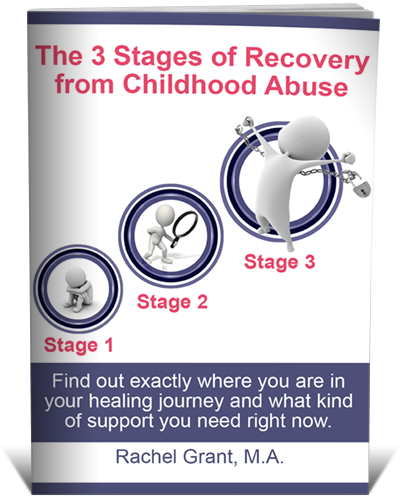
Discover the 3 Stages of Recovery from Childhood Abuse

The road to recovery is much easier when you know what stage you're in and what to do next. Find out exactly where you are in your healing journey and what kind of support you need right now. 
This FREE 9-page guide will give you the answers you've been seeking.


April 6, 2011

Lessons from the Country - Part 2

It's amazing to me that only a few weeks ago I was in a cabin in the country spending most of my time in a state of either relaxation or reflection. Now that I'm back in the city, responsibilities and appointments are back on the table, but how I'm managing and balancing things is very different now due to another lesson I learned from the country.

As I sat at the bar next to one of the local guys who was very kindly sharing bits and pieces from his life story, I would from time to time send a text or check email. He laughed a little and broke off from his story about playing baseball to jest, "Ya know, like back when people could talk without a machine involved..." I didn’t feel offended or chided. Rather I appreciated this jovial reminder that I was, after all, here partly to unplug. So, I tucked my phone away and enjoyed the rest of the evening chatting and learned a lot about the surrounding towns and the history of Clear Lake.

I also noticed as I strolled the small town streets that there were no near bodily collisions due to the text & walk action you see on city streets. People were strolling, taking in each other or their surroundings. They seemed to know and remember life without a harried pace that required constant effort, communication, and progress.

So, as I returned to the city I had it in mind to make a few changes as a result of these kind reminders. The first thing I wanted to do was break up with my phone. We had a long talk and I explained that, while I loved many things about it, I needed to have more time for myself and others. So, the phone has been banned from the car, the dinner table, when out walking, and any time when my attention should be on working or enjoying the company of others. To be sure, I might break this rule from time to time, but nowhere near as often.

Next, I carved out at least 30 minutes a day for time when there is no computer, no TV, no phone – a time of sanctuary in which to relax and reflect (so that maybe, when I go to the country again, it won’t be to recover but simply to enjoy the change of scenery). This is actually something that many time management coaches recommend. We’ve bought into the idea that every minute of the day should be filled with productivity, but research actually shows that we are more productive when we give ourselves regular breaks.

All in all, I’m trying to enjoy the country pace while still managing the demands of day to day life. When I start to feel rushed or overwhelmed, I just remember what my dad used to say, "Chickens may run faster with their heads cut off, but, honey, they have no heads!"

I encourage you to try one or two of these little tricks to help you slow down, unplug, or tune in to what's happening right in front of you!


---

Discover the 3 Stages of Recovery from Childhood Abuse

The road to recovery is much easier when you know what stage you're in and what to do next. Find out exactly where you are in your healing journey and what kind of support you need right now. 
This FREE 9-page guide will give you the answers you've been seeking.

March 30, 2011

Getting the Results You Want

"Current research underscores the wisdom of [Benjamin Franklin's] chart-keeping approach. People are more likely to make progress on goals that are broken into concrete, measurable actions, with some kind of structured accountability and positive reinforcement." ~The Happiness Project

I couldn't agree more, which is why one of the main things I do with my clients is create "measurable results", even when it comes to abstract ideas like worthiness, confidence, or communication. I love seeing things become focused and manageable as my clients get clear about the small strides they can take towards a larger goal!

So, what exactly is a measurable result? Overall, it's the objective means by which you can measure your progress. To develop a measurable result, there are few steps you can follow. The first step is to first of all identify the overall goal. For example: to spend more time with friends. This statement is clear, but it is still way too general to inspire action or be measured. Yet, being able to state your goal in a broad stroke is useful as a way to get the ball rolling. We’ll worry about making the goal more concise later.

The next important step is to identify why you want to pursue this goal in the first place. This step often gets skipped or people are unaware of it altogether, but it's actually the most important step in the whole process. It provides the underlying motivation that creates momentum, commitment, and endurance. In addition, reflecting on the “why” is important in order to check in and assure that your reasons are not in some way harmful to the endeavor. So, a healthy motivation might be: to create meaning and deeper connections and to share myself with others. A not so great motivation might be: to prove that people like me.

Once you’ve identified the goal (what) and the motivation (why), next comes the how and how often. Without this step, your goal is likely to remain a nice idea that is never put into action. Brainstorm a few ways that you could spend more time with friends. You could plan dinners, make a phone call, meet for coffee, or take up an activity together. This is your how. Then you need to decide how much time you’ll spend each week on this particular method designed to lead to the ultimate outcome of spending more time with friends. It should be specific – e.g. you may decide to have friends over to dinner twice a week.

Finally, you need to decide how you will track your progress in a way other than in your head. We are funny creatures in that the times we don’t meet our goals stick out to us so much more easily than when we do follow through. So, we need a tangible way to see what's actually going on. You could make a tally chart, mark it in your calendar, have a friend book that people sign when they come for dinner. Just choose any method that you'll enjoy using to track your progress and that doesn’t just feel like more work.

I'll also add that the mindset you have after setting a goal and putting it into action is critical. You won’t be perfect, and, if you allow the times when you don’t meet your goal to mean that you'll never do it or you'll never change, then it doesn’t matter how measurable the goal is, you will lose heart and abandon the goal. To keep this in check you can enroll others who will support you and remind you to take one day at a time, practice being forgiving and kind to yourself, and be flexible. If you are really struggling to meet your goals, allow yourself to reevaluate and adapt. Maybe it turns out that dinner twice a week isn’t realistic - so drop it down to one. Bottom line, measurable results are meant to help you objectively measure your progress, not your value or capability.

Are there things you've wanted to change, but you're stuck either because the task seems too big or you just don't know where to start? 


---

Discover the 3 Stages of Recovery from Childhood Abuse

The road to recovery is much easier when you know what stage you're in and what to do next. Find out exactly where you are in your healing journey and what kind of support you need right now. 
This FREE 9-page guide will give you the answers you've been seeking.

March 25, 2011

Lessons from a Country Girl - Part 1

Last week, I spent seven days near Clear Lake, CA. Now, I didn’t feel like a fish out of water – far from it. I grew up in Oklahoma so I felt right at home (though to be sure California country is a tad bit different from Oklahoma country). I soaked in the slow pace, enjoyed a day at the cabin doing nothing but reading and cozying up near the fireplace, and generally allowed my mind and body to relax.

I spent lots of time driving the winding country roads through little towns boasting populations of 60. I sat at the bar with the locals and chatted about the weather, their lives, Facebook (I know!!), and the general state of the world. I have to say, this was the highlight of the trip. The ease with which people strike up a conversation in these small towns struck a chord with me. I have this same natural inclination – one has to after years of watching my folks talk to just about anyone just about anywhere – but it’s definitely stifled in the city. Moreover, I know many of those in my circle, even minus the country upbringing, feel stifled in this same way. We walk around with our heads down, avoid eye contact, always leave a space between ourselves and the other person at the bar. It’s amazing that, with a multitude of opportunities to enjoy other people, city dwellers end up feeling the most disconnected and alone. What’s up with that!?

I noticed two things going on that I think partly explain why people in the country are able to share with such ease. First of all, there is less risk in the country because there is a greater likelihood that the person you cross paths with is actually someone you already know. They have a deeper sense of who it is they are engaging, so are not inhibited by the initial fear of the unknown. As I thought about this, though, I just had to laugh. Surely the city can’t be so teeming with undesirable people that we can’t even risk saying hi over a beer or smiling at a stranger as we walk down the street!

Secondly, people return to their same local bar all the time – I mean, they may only have three to choose from after all! In doing so, they see the same faces, get to know the bartender, and, most importantly, gain a sense of ownership of the place. It becomes a bit like home, so, of course, when someone comes to your home, you don’t ignore them! You welcome them, find out what they’d like to have, and learn about who they are.

In the city, we have hundreds of bars from which to choose (this has its own richness and benefits – definitely not trying to completely bash the city here). I’ve mentioned before how sometimes having too many choices actually leaves you worse off than only having a few in being able to connect and build friendships. I think what happens in this instance is that people lack a sense of belonging, ownership and the resulting ease and so become stifled and closed off, because they never go to the same place more than a few times. They have no “home base” so to speak.

So, Lesson #1: Create a home base, take the risk and start a conversation, and smile at strangers

Now, your home base doesn’t have to be a bar, but it should be a place you can easily get to and that’s small enough that some of the same people might show up over and over again.

You can strike up a conversation anywhere – in the grocery line, at the bus stop – but definitely practice this at your home base often!

As to smiling at strangers – well, you can do that one anywhere!


---

Discover the 3 Stages of Recovery from Childhood Abuse

The road to recovery is much easier when you know what stage you're in and what to do next. Find out exactly where you are in your healing journey and what kind of support you need right now. 
This FREE 9-page guide will give you the answers you've been seeking.

March 9, 2011

Article: The Trouble with Bright Girls

I just had to share this article I recently came across: The Trouble with Bright Girls

I won't say much about it other than that it's definitely worth the read and that I particularly like this bit:

"Why does this happen? What makes smart girls more vulnerable and less confident when they should be the most confident kids in the room? At the 5th grade level, girls routinely outperform boys in every subject, including math and science. So there were no differences between these boys and girls in ability, nor in past history of success. The only difference was how bright boys and girls interpreted difficulty -- what it meant to them when material seemed hard to learn. Bright Girls were much quicker to doubt their ability, to lose confidence and to become less effective learners as a result."

This stood out to me, because I do a lot of work with my clients around how they are interpreting their experiences and the behaviors of others to see how those interpretations are getting in the way of them moving forward, connecting, or seeing things objectively.

Check out the article -- I would love to hear your thoughts.

Are you a bright girl who has noticed herself evaluating your ability in the way Grant Halvorson describes? If you're a bright boy, do Grant Halvorson's observations resonate with you?


---

Discover the 3 Stages of Recovery from Childhood Abuse

The road to recovery is much easier when you know what stage you're in and what to do next. Find out exactly where you are in your healing journey and what kind of support you need right now. 
This FREE 9-page guide will give you the answers you've been seeking.

Sign up for my free guide so you can stop spinning your wheels and instead navigate your way through each stage of recovery with ease and clarity. Get the support you need today